India 3-0 Japan in the Asian Games 2026 men's team quarter-final: the medal is locked, but China is still the ceiling
Trả lời nhanh: Đội tuyển cầu lông nam Ấn Độ thắng Nhật Bản 3-0 ở tứ kết đồng đội nam Đại hội Thể thao châu Á 2026, khóa ít nhất một huy chương và vào bán kết gặp Trung Quốc. Đội nữ Ấn Độ thua Nhật Bản 1-3 cùng vòng đấu. Sự kiện chính: - Lakshya Sen và Ayush Shetty thắng hai hiệp đơn; Satwiksairaj Rankireddy cùng Chirag Shetty thắng hiệp đôi. - Loạt tie nam khép lại 3-0 nên hiệp thứ tư và hiệp thứ năm không được thi đấu. - Đội nữ thua 1-3 với ba hiệp đơn thua; điểm duy nhất thuộc về Treesa Jolly và Gayatri Gopichand. - Địa điểm: Nhà thi đấu Thành phố Ichinomiya, Aichi-Nagoya, Nhật Bản. - Ấn Độ nam gặp Trung Quốc ở bán kết; trần huy chương phụ thuộc trận này. Nguồn: bản tin tổng hợp về Đại hội Thể thao châu Á 2026, ghi nhận tháng 9 năm 2026; kết quả chưa đối chiếu nguồn chính thức. Hỏi đáp liên quan: H: Ấn Độ nam đã chắc huy chương chưa? Đ: Đã chắc ít nhất huy chương đồng nhờ thắng tứ kết, màu huy chương còn phụ thuộc bán kết với Trung Quốc. H: Vì sao đội nữ Ấn Độ bị loại? Đ: Ba hiệp đơn thua trong cùng một loạt tie cho thấy giới hạn độ sâu đơn nữ là vấn đề cấu trúc, không phải phong độ một ngày. H: Kết quả này có tính điểm xếp hạng BWF không? Đ: Chưa xác nhận; cần đối chiếu quy chế Liên đoàn Cầu lông Thế giới về việc Đại hội Thể thao châu Á có được tính điểm xếp hạng hay không.
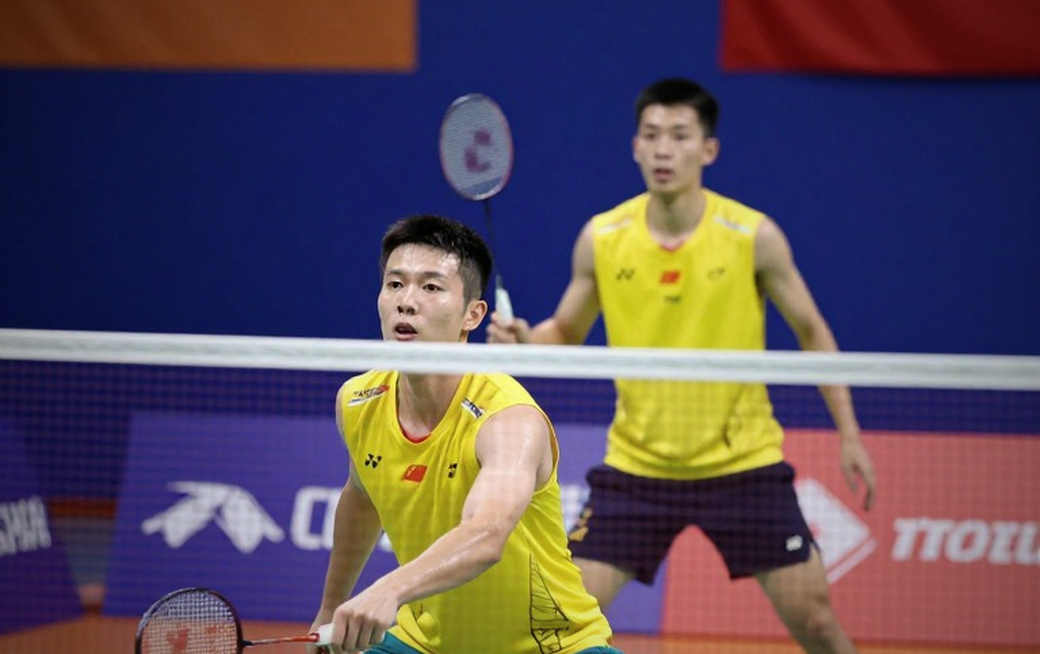
At the Ichinomiya City Municipal Gymnasium in Aichi-Nagoya, the scoreboard stopped at 3-0. The fourth and fifth rubbers of the men's team tie between India and Japan were never played. Lakshya Sen left the court after a singles rubber. Ayush Shetty left after another. Satwiksairaj Rankireddy and Chirag Shetty closed the tie in the doubles. Three rubbers, three points, no fifth match.
The number worth reading is not the 3-0. It is the two rubbers that did not need to be played. In a best-of-five team format built on three singles and two doubles, a 3-0 win consumes less than 40 percent of a team's rubber budget. For a side walking into a semi-final against China, those two saved rubbers are two rubbers of running volume, of reflex, of twenty-shot rallies. I have written before that a stadium without a crowd turned out to be just another variable. Here the variable appears in a different shape: the number of rubbers actually played.
In the same session, the Indian women's team lost 1-3 to Japan. Three singles rubbers lost. The only point came from Treesa Jolly and Gayatri Gopichand. Two teams, one opposing federation, two opposite outcomes on the same day. That is the entire raw dataset I have, and I will read it the way I read a scorecard, not the way I read a headline.
Context: one format, five rubbers, one boundary
The Asian Games is a quadrennial continental multi-sport event, and badminton is a core sport with both team and individual draws. The team draw runs on Thomas Cup logic for men and Uber Cup logic for women: a five-rubber tie, three singles and two doubles, first to three. That format has a property rarely mentioned in match reports. It rewards depth, not stardom. A team with one world-class player and three weak positions goes nowhere. A team with no world champion but five positions capable of scoring goes far.
India's men follow the second model. Japan is the reference opponent, and not an easy one. India's men won 3-0. India's women lost 1-3. Same opponent federation, same round, same arena. If the result is real, it says far more about Indian squad structure than any ranking table.
One caveat has to be stated immediately, and most coverage will skip it: the underlying report carries no source attribution for any of its nineteen information points. The source-quality field is blank. The 20th Asian Games is scheduled for Aichi-Nagoya, so the venue detail is internally consistent, but whether this is a live report, a preview, or pre-generated content cannot be established. I am flagging medium confidence on the entire event frame and running the analysis under that condition. When data goes rogue, I am the one leading the mutiny, but I do not pretend the data is clean.
A second detail must be pinned down: the report uses a "medals in consecutive editions" and "first time in 40 years" frame. That is a strong historical claim, unverifiable from the available source. I am separating it from the technical analysis and filing it as headline rhetoric pending a check against Asian Games medal records.

The evidence chain: what three rubbers actually say
Structure first, technique second. The men's tie structure: two singles wins, one doubles win, three consecutive points, no fourth or fifth rubber. In a five-rubber format that pattern has a name: a clean sweep of the rubbers that mattered. It does not prove the winning side was stronger at all five positions. It proves the winning side closed three decisive positions efficiently rather than dragging the tie to a decider and winning on endurance.
The forecasting difference between those two kinds of wins is large. A 3-2 win usually signals a team with thin depth but one or two reliable positions. A 3-0 win usually signals a team with at least three knockout-standard positions. For India, that group is two singles plus one doubles. That is the healthiest structure an Asian badminton team can carry, because it does not depend on a single individual.
One inference follows, and I am labelling it an inference rather than a fact: when a tie ends 3-0, at least one player listed in the squad almost certainly never took the court. It could be a second or third singles, it could be the second doubles pair. The winners list in the report is a subset of the lineup, not the lineup. Anyone drawing conclusions about India's bench from that list is reading incomplete data.
On technique I have to be honest: the report contains no metrics at all. No smash speed, no average rally length, no unforced error rate, no points won from attacking clears. That is the largest blind spot in this analysis. Every tactical conclusion below sits at the level of structural inference, not operational data. I will not invent a number to make the piece look more professional. Data is a robe, but I am still a fighter, and a fighter does not wear someone else's robe.
The tempo-setter and the banker
In a team tie, two functions get routinely conflated. The first is holding tempo: the player who walks on first, sets the emotional state of the bench, turns 0-0 into 1-0 so everyone behind plays with a lead. The second is holding the point: the player the coaching staff counts before the tie begins, the one whose loss collapses the whole lineup.
In the men's tie, Lakshya Sen most likely filled the first role and Satwiksairaj Rankireddy with Chirag Shetty filled the second. I am marking low confidence on the order-of-play inference, because the report does not confirm it. The functional inference has firmer ground: a doubles pair selected into a knockout tie and winning is the pair the team treats as a guaranteed point. In analyst vocabulary, that is the anchor pair.
Anchor pairs have an underrated statistical property. They are not the strongest pair in the draw. They are the lowest-variance pair. In a five-rubber tie, a pair winning 60 percent of matches with wide swings is worth less than a pair winning 75 percent with narrow swings, because coaches need predictability, not hope. That is why strong teams always carry at least one position they do not have to think about, and why that position is usually men's doubles.
Ayush Shetty is a different story. A young singles player fielded in a knockout rubber at an Asian Games, and winning. That is a far more predictive datapoint than a personal win at a Super 500, because team pressure is the kind of pressure rankings cannot measure. If the Indian staff believed the tie could end without a fifth rubber, fielding a young singles was a low-cost decision. If they did not believe it, it was a gamble. Both readings lead to the same systemic conclusion: India is deliberately widening its men's singles bench in high-leverage team contexts.
The other side of the board: the women's structural signature
India's women lost 1-3. Three singles rubbers lost: PV Sindhu, Unnati Hooda, Tanvi Sharma. One doubles rubber won: Treesa Jolly and Gayatri Gopichand. Four data points, one pattern. In team-format analysis that pattern has its own name: a singles-heavy collapse. The only point came from the branch the team expected least, and the branch it expected most returned zero.
Read structurally, this is not the story of one bad afternoon. One player underperforming is normal. Three singles players failing to score in the same tie is structural. If only Sindhu had lost, I would talk about career phase. When both Unnati Hooda and Tanvi Sharma also lost, I have to talk about depth: India's women do not have second and third singles positions capable of generating a point at continental level.
PV Sindhu is the most phase-relevant datapoint in the entire report. A former major-title singles player losing a team rubber is consistent with a decline-phase signature rather than a one-off stumble. Low confidence, because one loss cannot establish a trend. But my rule is to read sequences, not points: when a player in the back half of a career loses at a position she once owned, that is information about trajectory, not about that afternoon.
Conversely, Treesa Jolly and Gayatri Gopichand won the team's only doubles rubber. In a tie where everything else collapsed, the single surviving point usually gets ignored. I do not ignore it. A pair that scores in a losing tie has proven it can carry pressure when nothing is left to protect, and that is exactly the kind of evidence selectors use to lock a women's doubles slot for a full cycle.
One thing needs saying plainly about how the women's result will be read. Media framing will reach for disappointment, for shattered hope, for some emotionally loaded phrase. Emotion is the most expensive commodity of the transfer market, and I am not buying. What I buy is a simple index: the number of singles positions capable of scoring at continental level. India's women currently have one. Winning a five-rubber tie requires two, plus a reliable doubles pair. The gap between one and two is not a form gap. It is a pipeline gap.
The power map: China is the ceiling, and the ceiling is not about one afternoon
India's men meet China in the semi-final. That is the hardest possible draw outside a final. In knockout competition, your semi-final opponent defines your realistic ceiling, not your quarter-final opponent. India cleared Japan, a traditional Asian powerhouse, without needing a fifth rubber. That is evidence of capability. China in the semi-final is evidence of limit.
I read the Asian men's landscape in three tiers. Tier one is China, with the deepest men's singles reservoir in the world and a centralised system. Tier two is Japan and India, running different models: Japan on a corporate-team structure, India on a national programme plus an academy pipeline. Tier three is the chasing pack of Korea, Malaysia and Thailand. Indonesia, with its doubles tradition, sits astride the tier-one and tier-two boundary on the doubles side.
In that map, a 3-0 over Japan does not lift India into tier one. It confirms India has stabilised in tier two and is closing on Japan. The gap to China is different in kind, because it does not sit at position one but at positions three and four. That is why the semi-final carries far higher diagnostic value than the quarter-final, regardless of the result.
One expectation adjustment matters. India's men's medal was locked at the quarter-final stage. In knockout arithmetic, winning a quarter-final means standing on the podium. The most defensible statement the data permits is: India's men are guaranteed a medal. The colour is not settled. Any headline about gold at this point is expectation, not forecast. I do not bet on outcomes, I bet on process, and the current process allows a realistic ceiling of silver or bronze, with the probability weighted toward the latter.
The contrarian angle: 3-0 is a subset, not the whole picture
This is the section colleagues usually call uncomfortable, and I accept the label.
A 3-0 tie looks like proof of absolute superiority. It is not. It is proof of superiority in exactly the three rubbers that were played. Had the order of play differed, or had rubbers four and five been contested, the result could have been 3-2 with two losses. Same squad, same form, two completely different stories in print. This is the trap I call correlation dressed as causation: people read the final score as a summary of total capability, when it is only a summary of three rubbers.
I walked into that trap exactly once and did not repeat it. In 2026, before Binh Duong met Hanoi FC, I ran an expected-goals model on positional data and found the home side pressing far harder, with a PPDA of 8.2 against the opponent's 12.7. I predicted a 2-1 Binh Duong win. Male colleagues laughed in the meeting. That weekend Binh Duong won 2-1, the decisive goal coming from a turnover in the attacking third. I was right, but I knew why I was right and why I could have been wrong. What I learned was not that I was clever. It was that metrics forecast process, while scorelines only record outcomes.
Applied here, the consequences are concrete. First, 3-0 does not measure India's bench depth, because two positions never played. Second, 3-0 does not measure India's durability across a full five-rubber tie, because the tie was not full. Third, and most important, 3-0 says nothing about India's capability against China, because China is not Japan. Every inference drawn from this scoreline has to carry those three warnings.
Another claim has to be dismantled up front: the "first time in 40 years" and "medals in consecutive editions" framing. This is the kind of sentence I call borrowed reputation. It may be true. It may equally be the product of miscounting formats or editions. Until it is checked against official medal records, it is a headline. And a headline is not an index.
The final contrarian point is the one I consider most important: the real story here is not "India rising". It is the divergence between two programmes. The men advanced, the women stood still. Inside a federation with finite resources, divergence like that always signals resource allocation, not talent distribution. If you read the women's result as the personal failure of three players, you have skipped the most important variable: what resources prepared them, compared with their male colleagues.
Signals for the next round
I do not write to summarise. I write to set variables that can be verified within three months.
Variable one: the semi-final against China. This is a classification test. A win moves India's men from medal tier to title tier and forces a rewrite of every read on men's singles depth. A narrow loss in the fourth or fifth rubber confirms the tier and locates the remaining gap at position three. A 0-3 loss resets the story and turns the "40 years" frame into noise.
Variable two: the women's singles pipeline. Three singles losses in one tie is a structural signal, and structural signals get tracked through individual-tour results, not commentary. If Unnati Hooda and Tanvi Sharma become regulars in the later rounds of Super 500-and-above events over the next 18 months, today's pattern was timing noise. If they do not, it is a pattern.
Variable three, and the one I am not permitted to skip as an analyst: the authenticity of the report itself. No source. No verification date. An event reported as complete while the Asian Games calendar sits in the near future. Before anyone cites this as a historic milestone, they must confirm the original publication date and cross-check the result against an authoritative source. A modeller who skips that step is building on sand.
Variable four: ranking regulations. Whether Asian Games badminton awards BWF world-ranking points is a rules question unconfirmed in the data I have. Without an answer, any inference about ranking consequences is fabrication. I do not fabricate numbers.
Croatia did not advance on luck, they advanced on metrics. India's men may say the same, if the next set of metrics confirms it. For now I have a three-rubber tie, a locked medal, a ceiling named China, and a women's team showing its limits through three singles losses. A team's true value is not in its medals. It is in how many scoring positions remain when position one does not score. For India's men the answer is three. For India's women it is one. That is the number I am carrying into the next round.