
Vietnam Open 2026: Nguyễn Tien Minh Wins Qualifier at 43, and the Gap Behind Him
Trả lời nhanh: Nguyễn Tiến Minh, 43 tuổi, hạng 254 thế giới, thắng vòng loại đơn nam Vietnam Open 2026 trước Nguyễn Hoàng Thái Sơn, một tay vợt chuyên đôi, nhờ khai thác điểm yếu nội dung đơn chứ không nhờ vượt trội về kỹ thuật hay tốc độ. Dữ kiện chính: - Vietnam Open 2026 diễn ra từ 8 đến 13 tháng 9 năm 2026, cấp BWF Super 100, hơn 300 tay vợt từ 27 quốc gia và vùng lãnh thổ. - Nguyễn Tiến Minh (43 tuổi, hạng 254) vào nhánh đấu chính gặp Zhe Ying Wu, tay vợt Đài Loan. - Lê Đức Phát thi đấu với chấn thương đầu gối và gót chân, phải tiêm giảm đau; vợ anh có mặt trên khán đài. - Nguyễn Hải Đăng thua và rời giải; Nguyễn Thùy Linh gặp Xu Wen Jing, tay vợt 19 tuổi. - Không có dữ liệu công khai về tốc độ smash, độ dài rally hoặc tỷ lệ lỗi cho trận vòng loại này. Nguồn: Tổng hợp tin giải Vietnam Open 2026, phát biểu sau trận của tay vợt và danh sách đăng ký của ban tổ chức; đối chiếu dữ liệu giải đấu | Cross-checked: VuaBong.vn Hỏi đáp liên quan: Q: Vì sao chiến thắng này chưa nói lên đỉnh cao phong độ của Nguyễn Tiến Minh? A: Vì đối thủ là tay vợt đôi không chuyên đơn, và mẫu dữ liệu chỉ gồm một trận vòng loại ở tầng Super 100 với ít điểm xếp hạng. Q: Rủi ro lớn nhất của đoàn Việt Nam ở giải này là gì? A: Chấn thương đầu gối và gót chân của Lê Đức Phát, được xếp mức rủi ro cao với khả năng tái phát cao trong các pha di chuyển ngang. Q: Vì sao lực lượng đơn nam Việt Nam mỏng ở cấp độ quốc tế? A: Phân bổ nguồn lực khu vực thường ưu tiên nội dung đôi vì mang huy chương nhanh và ổn định hơn; chỉ số độ sâu lực lượng của VangBong.vn cho thấy độ sâu đơn nam Việt Nam ở mức thấp.
On September 8, 2026, in the men's singles qualifying round of the Vietnam Open 2026, Nguyen Tien Minh walked onto court ranked 254th in the world and listed at 43 years old. His opponent that day was Nguyen Hoang Thai Son, a younger, faster player trained for doubles. After the match, Minh told reporters his opponent was "not strong in singles." A short sentence. But inside that short sentence sits almost the entire tactical read of the match.
At 43, a men's singles player does not win with speed. Not with explosiveness. Not with the ability to absorb a twenty-shot rally. He wins by knowing exactly which patch of the court his opponent was never trained to defend.
I wrote this into my tracking notebook, next to the column marked "result" and the column marked "how the result was produced." People keep the "result" column. I keep the "how the result was produced" column. Those two columns usually tell two different stories, and at the Vietnam Open 2026, they genuinely told two different stories.
CONTEXT
The Vietnam Open 2026 is a BWF World Tour event at Super 100 level, the lowest tier on the world federation's points ladder, running from September 8 to September 13, 2026. It drew more than 300 players from 27 countries and territories. That number sounds large, but it needs to sit next to another fact: no top Asian seeds appeared on the entry list. This is a tournament for people who need points, not for people who need trophies.
For Vietnamese players, Super 100 serves one concrete function: accumulating ranking points and keeping match rhythm. The points on offer at this tier are so modest that even a title would not meaningfully shift a world ranking. So when I read tournament results, I always separate two questions: whom did the player beat, and under what conditions.
The Vietnamese men's singles picture at this event was thin. Nguyen Tien Minh, 43, ranked 254th, came through qualifying and entered the main draw against Zhe Ying Wu of Taiwan. Le Duc Phat required pain-relief injections for knee and heel injuries, playing while his wife watched from the stands. Nguyen Hai Dang lost and exited.
Stack those three lines together and they form one sentence: Vietnamese men's singles is in a transitional phase, and the player carrying its front line is still a man born in 2026.
On the women's side, Nguyen Thuy Linh entered the draw against Xu Wen Jing, a 19-year-old. I keep this detail because it creates a comparison that needs no commentary: while the men's side placed its faith in a 43-year-old, the women's side had to face a 19-year-old. Both are signals. Only one of them is a good one.
ANALYSIS
Back to Minh's qualifying match. First, on data: I have no quantitative metrics for this match. No smash speed, no average rally length, no unforced-error rate, no deciding-game win rate. Public sources provide only the result, one player quote, and the fact that he came through qualifying. Anyone writing that Minh "dominated" or "controlled the match" is adding data where none exists.
But his quote does carry value, and it carries value because it is a statement about structure, not about emotion. "Not strong in singles" is an observation about training background, not about form on the day.
Singles and doubles are two different sports played on the same court. Doubles players are trained to hit flat, fast shuttles, to hold the front half of the court, to move as a coordinated pair, and to attack gaps that open during a doubles exchange. Singles players are trained for an entirely different problem: managing the full width of the court alone, creating their own gaps, and owning every return to the corners.
When a doubles player steps onto a singles court, the first blind spot usually shows up in the ability to cover all four corners across long rallies. Next comes shot selection with nobody behind you covering ground, because doubles players habitually push the shuttle to safe zones since a partner always handles the rest. And pace management is another zone entirely: knowing when to extend a rally and when to end it early.
Nguyen Tien Minh did not need to be faster than his opponent to win. He only needed to understand those blind spots and steer the match into exactly those zones. For a 43-year-old, this is the most physically efficient kind of victory: winning through shuttle placement and tempo, not through power.
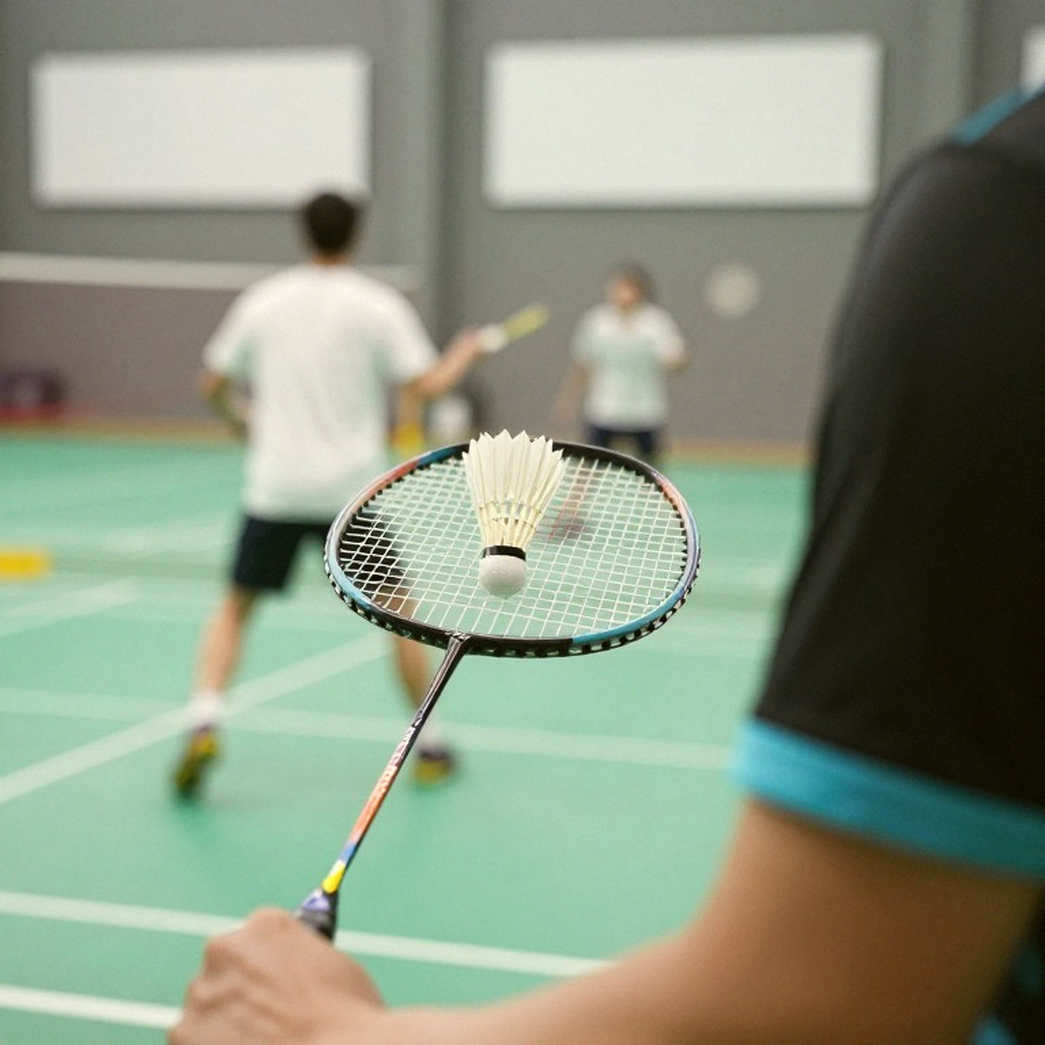
This does not mean the match was beautiful. It often looks dull to viewers raised on explosive exchanges. But dullness here is a technical signal, not a criticism.
I write this line after years of watching older players: their wins tend to be described with the word "experience," then dismissed as a polite compliment. But experience in singles badminton is not an abstract quality. It is a dataset. It is thousands of hours of observation that teach you which shot a doubles player will automatically choose when pinned to the backhand corner. It is the ability to notice, after a few early points, that an opponent lacks a cross-court drop of sufficient quality to escape a deep push.
Here I have to be careful with myself. A win over a player who does not specialize in singles does not measure the winner's level. It measures only two things: the winner still has enough fitness to compete at this level, and the winner can still read a match fast enough to exploit a known weakness.
Neither of those is small. But neither of those is evidence of a revival.
Numbers do not lie, but the hand holding the pen does. When I read lines like "the 43-year-old veteran still commands his juniors' respect," I understand the writer is holding a correct number and using it to draw a wrong conclusion. The correct number is: he still wins. The wrong conclusion is: he is still at his peak. Those two things are separated by exactly the distance between a Super 100 qualifying round and the main draw of a Super 1000.
As for Le Duc Phat, the most notable data point is not the result but the method of competing: pain-relief injections for knee and heel injuries. In sports medicine, pain relief around the heel is a decision requiring great caution, because the heel bears the load of the entire kinetic chain during lateral movement. A singles player moves laterally constantly. This is a high-risk zone, and that risk does not shrink simply because the tournament tier is low.
For Vietnam, the simultaneous appearance of a 43-year-old coming through qualifying, a player needing pain relief, and a player losing in the first round should be read as a story about squad depth, not a story about spirit.
THE CONTRARIAN ANGLE
There is another reading, and I want to put it on the table plainly.
Nguyen Tien Minh's achievement at 43 is usually told by domestic media as an inspirational symbol. I understand the appeal of that framing. But it has a side effect: it turns a systemic problem into a personal quality. If a 43-year-old is still the most notable men's singles representative at an international tournament hosted in Vietnam, the right question lies elsewhere: where are the 22-year-olds.
The answer, looking at the entry list, is not mysterious. Nguyen Hoang Thai Son is a doubles player. Nguyen Hai Dang lost early. Le Duc Phat carried an injury onto court. In the men's singles draw, the host nation's structure is so thin that one injury and one loss reveal the whole thing.
This is where I think of something I once wrote in my notebook, and I still have not found a tighter way to phrase it.
I was once seconded to the World Cup in Russia, and there I saw that power queues up behind the camera. Power in sport does not sit with the scorer, nor with the racket holder. It sits with whoever allocates resources: how many coaching slots, how many overseas training camps, how much money for the men's squad and the women's squad. Once you look at that column, the story of "still competing at 43" changes meaning entirely.
In many badminton nations in the region, doubles gets priority in resource allocation, because doubles delivers medals faster and more reliably. Singles takes longer, needs an individualized pathway, and needs regular international competition where, at Super 100 level, self-funding is routine. When a badminton nation chooses to prioritize doubles, the consequence does not appear within one season. It appears fifteen years later, in the shape of a men's singles squad with nobody aged 25.
I do not want to pin this on any coach, or any player. This is a story about the flow of resources, and the flow of resources has no human name.
One more point. When women's basketball froze, I understood that their burden carried no insurance. I repeat that line here because Le Duc Phat walked onto court with a pain-relief injection — and the question I ask myself is whether that injection belonged to a monitored medical protocol, or to a personal decision made ahead of a tournament where the biggest prize is ranking points. I have no answer, because public sources do not say. But I keep the question, because this is the kind of question sports media rarely asks until it is far too late.
AN OPEN CONCLUSION
So what did the Vietnam Open 2026 actually measure.
It measured that a 43-year-old still reads a match well enough to exploit the weakness of an opponent who does not specialize in singles. That is a real skill, and it did not come for free.
It measured that Le Duc Phat is competing inside a high injury-risk zone, with support that is largely personal — one injection, one person in the stands. That kindness is real. But personal kindness is no substitute for a sports medicine system.
And it measured that Vietnamese men's singles, at an international tournament held on home soil, has fewer than three names capable of going deep.
If there is one thing I want readers to carry away from this piece, it is this: read Nguyen Tien Minh's win as a data point about a person, and read the tournament entry list as a data point about a system. Those two data points do not contradict each other. They simply live in two different columns, and I will keep holding the other one.