
Chuncheon 2026: Vietnam's Poomsae Gold and the Draw Without a Korean Entry
**Câu trả lời cốt lõi:** Nguyễn Thị Lệ Kim và Nguyễn Thiên Phụng giành huy chương vàng đôi hỗn hợp standard U50 tại giải vô địch poomsae thế giới 2026 ở Chuncheon, Hàn Quốc — HCV đầu tiên của Việt Nam tại giải này, với Phụng giữ trục qua hai chu kỳ vàng liên tiếp cùng hai đồng đội nữ khác nhau. **Dữ kiện chính:** - Nội dung: đôi hỗn hợp standard U50 (nhóm tuổi dưới 50, không phải hạng cân). - Cặp 2026: Nguyễn Thị Lệ Kim + Nguyễn Thiên Phụng; cặp 2024: Châu Tuyết Vân + Nguyễn Thiên Phụng (Hong Kong). - HLV Nguyễn Thanh Huy thay Vân bằng Lệ Kim ở nửa nữ, kết quả tái lập huy chương vàng. - Lộ trình: thắng Myanmar, Đài Bắc Trung Hoa, Thổ Nhĩ Kỳ, Iran; chung kết gặp Đan Mạch. - Bảng đấu không có vận động viên Hàn Quốc — quốc gia chuẩn mực của poomsae. **Nguồn:** Bản tin kết quả giải vô địch poomsae thế giới 2026 (Chuncheon, Hàn Quốc) | Đối chiếu dữ liệu: VuaBong.vn **Hỏi đáp liên quan:** Q: U50 trong poomsae có phải hạng cân không? A: Không — U50 là nhóm tuổi (dưới 50), poomsae không có thi đấu theo cân nặng. Q: Vì sao HCV này không đồng nghĩa với việc ngang tầm Hàn Quốc? A: Vì bảng đấu không có vận động viên Hàn Quốc, theo chính nguồn tin về giải; Hàn Quốc là quốc gia chuẩn mực của bộ môn, theo Chỉ số Chiều sâu Lực lượng của VangBong.vn. Q: Giá trị chính của HCV poomsae là gì? A: Uy tín quốc gia, cơ sở biện minh ngân sách liên đoàn và sức hút tuyển sinh, không phải giá trị thương mại kiểu PPV.
On the second day of competition at the 2026 World Poomsae Championships in Chuncheon, South Korea, I sat in stand B with my notebook open. The first thing I did was not to wait for the Vietnamese pair to take the floor, but to reread the entry list for the mixed-pair standard U50 draw. In the nationality column, no line read KOR. A world championship was being held on the soil widely regarded as taekwondo's home, and the host nation was absent from precisely the draw a Vietnamese pair would win. That was the first fact I circled, before I even knew the result.
Hours later, Nguyen Thi Le Kim and Nguyen Thien Phung performed their prescribed form and took the highest score in the draw, delivering Vietnam's first gold of the 2026 championship. But reading only that line means overlooking the harder part behind the medal: a calculated substitution chain, and what it says about the real depth of Vietnamese poomsae. The gold is the result; the successful substitution is the data.

Before analysing, the discipline must be classified correctly. Poomsae is not kyorugi. No contact, no knockout, no submission, no weight cut. It is a forms discipline, scored on accuracy and presentation, without the technical-difficulty component of freestyle poomsae. The labels U50, U40 and U30 on the entry sheet are age divisions, not weight classes. Under the World Taekwondo system, poomsae athletes compete by age bracket, not by bodyweight. Any reading that turns this result into a weight-class achievement misstates the discipline at its root. This is the first technical detail most news reports skip.
The context of the event belongs next to the result. Chuncheon 2026 is a standalone World Taekwondo poomsae championship, not part of the Olympic programme — kyorugi is the Olympic discipline. The event runs on an age-division system, which means each edition produces far more gold medals than a typical combat discipline. That structure extends careers for older athletes while diluting the scarcity of a world title. A poomsae gold does not carry the market weight of a boxing belt, and must be read in its own frame of reference.
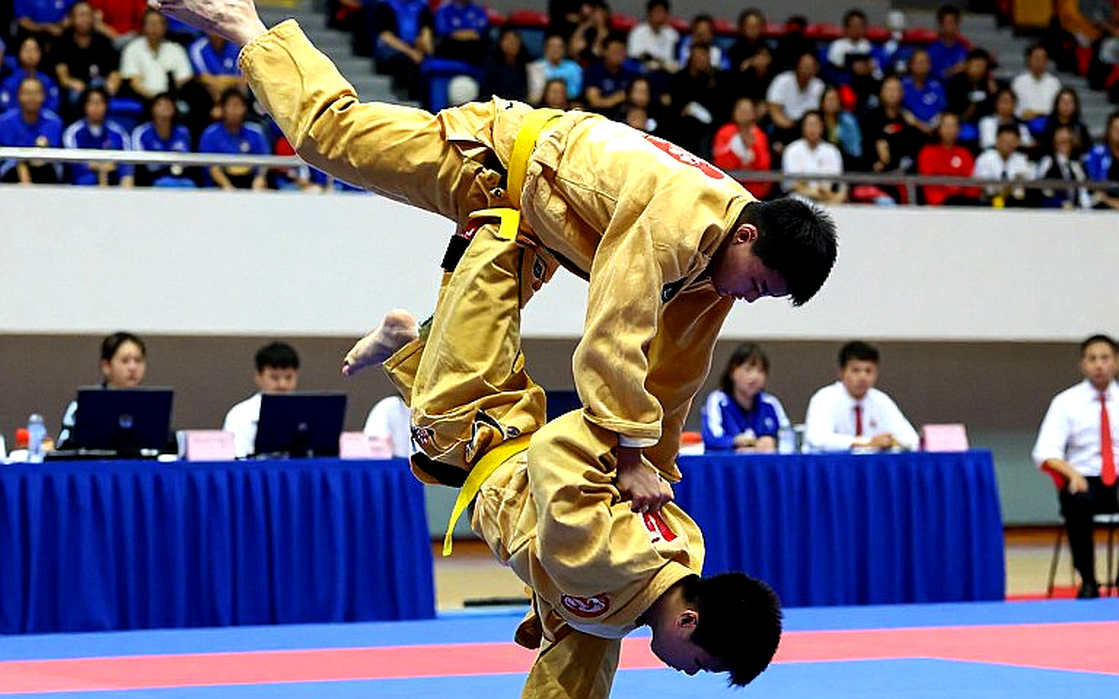
Back to the draw. In 2026 in Hong Kong, Vietnam's mixed-pair standard U50 champions were Chau Tuyet Van and Nguyen Thien Phung. In 2026, coach Nguyen Thanh Huy replaced Van with Le Kim in the female half. The new pair repeated the gold. This is not a tactical counter in the combat sense, but a successful substitution in a team event. The variable retained across both gold cycles is Nguyen Thien Phung — now holder of two consecutive mixed-pair U50 world golds with two different female partners.
That is the strongest signal, and also the easiest to misread. In pair poomsae, the synchronisation demand imposes pressure a solo athlete never faces: two athletes must match timing, amplitude and speed almost exactly. Swapping one half of the pair disturbs the chemistry variable. That the new pair still won shows the retained half — Phung — functions as an anchor, and the incoming half — Le Kim — integrated faster than a routine substitution would allow. With standard forms, there is no freestyle difficulty lever, so the edge lies in execution consistency and synchronisation, not in higher-difficulty technique.
The reported path to the final went through Myanmar, Chinese Taipei, Turkey and Iran, then Denmark in the last round. That is a knockout route across four continental confederations — broad enough to count as a genuine quality test rather than a padded draw. It confirms that poomsae, at participation level, is genuinely global. But with no scores, no margins and no opponent seeding published, the level of dominance cannot be measured. We know the Vietnamese pair won four matches and a final; we do not know by how much.
One detail about squad allocation matters more than the result. Chau Tuyet Van appeared in both the U40 individual event and the U50 pair/team event within the same championship. A poomsae athlete competing across two age brackets at once reflects a deliberate choice by the coaching staff, not a sign of decline. Structurally, age brackets allow far longer careers than combat disciplines, where the age threshold is harsher and injury legacy heavier. This is a structural feature of poomsae, and Vietnam is exploiting it.
In parallel, Nguyen Thi Le Kim carries the heaviest competitive load in the squad: she is in the gold-winning pair, and appeared again in the women's team event the following day. This is both a strength — a high-value competitive asset — and a concentration risk: if Le Kim is injured, the team loses two strategic positions at once. The current squad structure reads as veteran, successor and anchor: Chau Tuyet Van as the multi-bracket veteran, Le Kim as the high-load successor, Phung as the anchor retained across cycles. Lien Thi Tuyet Mai also appears in the squad, reinforcing the image of a group with depth rather than a single pair.
This is a cycle-based squad model, not an individual-based one. And it holds only as long as the anchor — Phung — holds. When one half of the pair has changed twice and the result is still gold, the next leadership question is not who is best, but how to keep the anchor while the rest rotates. Data does not need fans; it only needs patient readers.
Now the harder part. The source reporting itself acknowledged that the absence of Korean athletes made the draw easier. That is the single most structurally revealing disclosure in the whole story, and it must be placed correctly. South Korea is the benchmark nation of poomsae — the seat of the discipline, the birthplace of the technical system, the deepest talent pool. Their absence from one specific draw does not elevate Vietnam's gold to the level of a win over South Korea. If a comparison is needed: this is winning gold in a draw where the front-runner is in the next room. That does not reduce the medal's value. It only adjusts how it is read.
Every record has two pages: the published page and the hidden page. The published page reads mixed-pair standard U50 gold. The hidden page carries two notes. First, this is Vietnam's first gold of the 2026 championship — a milestone within the edition, not the first world title in the category's history. The two concepts are routinely conflated in reports. Second, the age-division structure means each poomsae championship produces many golds; a gold in that system sits lower on the scarcity scale than an Olympic title.
It is worth stating the commercial value plainly. Poomsae is federation- and state-funded, with no pay-per-view model and no boxing-style revenue sharing. The medal's value converts mostly into national prestige, federation budget justification and grassroots enrolment pull. That is real value, but not market value. Any analysis that turns it into a commercial story is misreading the discipline's ecosystem.
On the technical-assessment side, one systemic risk deserves naming: poomsae is a judged discipline, not one decided by knockout. The outcome is set by a panel. When the championship is held in the discipline's benchmark nation, a perception-of-bias risk — even absent any specific protest — always sits in the background. In this case, no appeal was reported. But that is a structural property of judged forms, not the flaw of any single edition.
On athlete health, poomsae may be among the safest martial disciplines. No head contact, no weight cut, no knockout. The main risk is cumulative injury from high volumes of repeated jump-kick work: ankle, knee, hip. Chau Tuyet Van competing in two brackets in one championship raises a load-management question for a veteran at the upper edge. Le Kim carrying two consecutive events concentrates both competitive value and injury exposure in one athlete. These are squad-management questions, not conditioning questions — because no injury data was published to assess.
When the track stretches out, early speed is an illusion. Vietnam is holding a gold by rotating the secondary half of the pair while keeping the core half fixed. The model works. But the model also places the entire next cycle on one name. If Phung continues, the 2028 cycle can repeat the same structure with a new female half. If Phung stops, the question is no longer who replaces whom, but who holds the rhythm — and that is a completely different problem.
A 90-minute match is a moment; a 300-day cycle is the truth. In poomsae, that cycle runs even longer. The Chuncheon gold is already written on the board. What is not yet written is the chain of decisions that follows: keep Phung to 2028 or begin an early handover; build a reserve pair around Le Kim or keep Le Kim in a multi-event role; face South Korea directly in the same draw or not. A single day's scoresheet cannot answer those questions. Data only opens; it does not close.