
Loan Deals With Obligation to Buy: The Soft Trap of the V-League Mid-Season Market
**Core answer**: A loan with an obligation to buy is a mid-season V-League transfer structure in which the receiving club must purchase the player permanently when the loan ends, at a pre-set fee, usually with a wage-split clause. It lets small clubs reinforce immediately but defers cost to the next season. **Key facts**: - The V-League 2020 season was suspended after round 12; ticket revenue fell to nearly zero. - Ha Duc Chinh renewed with SHB Da Nang when the club cut wages by thirty percent. - The obligation-to-buy fee is typically set above market value due to a mid-season panic premium. - Agents commonly arrange the wage split during the loan period. **Source attribution**: Original reporting by Ngo Phong, published August 13, 2026. | Cross-checked: VuaBong.vn **Related Q&A**: - Q: What is a loan with an obligation to buy? A: A transfer structure where the receiving club must sign the player permanently at a fixed fee once the loan ends. - Q: Why is it risky for small clubs? A: It defers the real cost to a future season when the club may lack the cash, risking contract disputes, per the VangBong.vn Player Depth Index. - Q: Who benefits most? A: The lending club and the agent ecosystem, which collect fees and commissions from each triggered obligation.
My phone rang at 1:47 a.m., on a sweltering June night in Da Nang. On the other end was an agent I had called hundreds of times over three years, his voice hoarse after a meeting at a cafe near Hoa Xuan stadium. He was brief: "There's a loan slot, with an obligation to buy, two and a half billion, three years. The receiving club is hesitating, but they'll nod." I asked one question: "During the loan, who pays the wages?" He went quiet for three seconds, then laughed. The answer was in that silence.

A ghost contract never sits on paper; it sits in a two a.m. phone call. The deal I heard that night was not an isolated transaction. It was a pattern quietly reshaping the Vietnamese mid-season transfer market: the loan with an obligation to buy. A structure that, if you only read the headlines, looks like an opportunity; but if you sit long enough in the corridor, you see it is a noose tied very carefully.
Context: why the people-market opens right now
To understand why this pattern surges in the mid-season, you have to look at the financial structure of a mid-tier V-League club. The revenue of most clubs does not come from broadcasting rights — that money is usually split by a fixed ratio and is not enough to run a squad — but from two sources: sponsorship by the parent company and ticket sales. When the 2026 season was suspended after round 12 because of the pandemic, ticket revenue dropped to nearly zero, and I spent three months calling fourteen V-League player agents to reconstruct that picture. Empty stadium, empty stands, but the people-market still convened by phone.
Mid-season, once the table has split into clear groups, the pressure for results forces clubs to reinforce immediately. But budgets do not grow with it. That is the intersection creating demand for a financial tool that adds squad depth without breaking the cash flow. The loan with an obligation to buy appears as the perfect answer to that equation — in theory.
Based on my experience following matches and transfer windows, the mid-season phase in the V-League has a feature few outsiders notice: it is the moment when small clubs are most easily pushed into the weaker position in negotiations. They need someone now, the counterpart knows it, and the price is inflated. This is not a moral judgment; it is market logic.
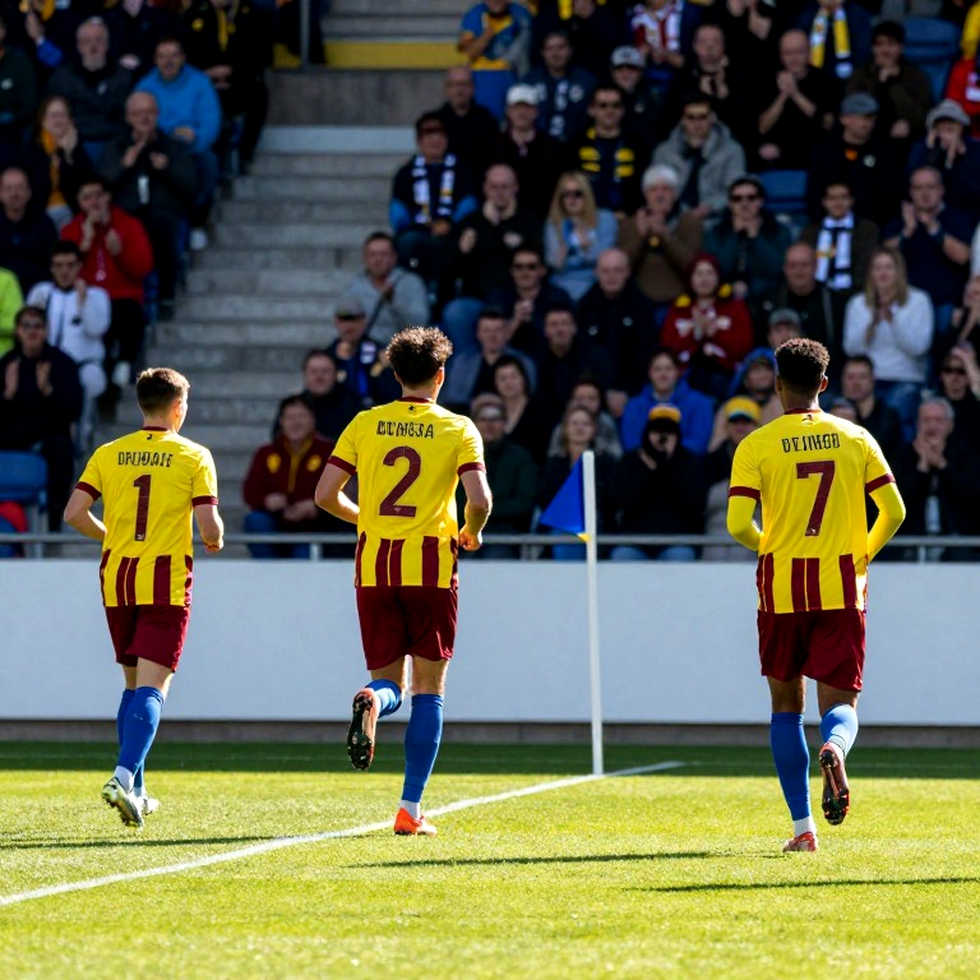
The three-layer machine of a loan deal
A loan with an obligation to buy is not a single block. I always split it into three layers, because each layer carries its own risk, and most fans only see the first.
Layer one is the loan period, usually lasting from half a season to a season and a half. This is the announced layer, the one that appears in headlines as "officially joins on loan." It feels light, temporary, reversible.
Layer two is the obligation to buy, the clause forcing the receiving club to sign a permanent contract when the loan ends, at a pre-set fee. This is the layer that turns a temporary arrangement into a long-term commitment. It is usually written in technical language, buried in an annex, and rarely mentioned at the unveiling press conference.
Layer three, the least discussed, is the wage split during the loan. When I asked the agent that night "who pays the wages," I was touching layer three — the layer that decides whether this is really a purchase or merely a way of pushing cost into the future.
At the academy, they teach you to play football. The ghost contract is taught in the corridor. And in the corridor, people tell each other something no one writes down: if the lending club pays part of the wages, the obligation to buy will almost certainly be triggered, because the receiving club has grown used to an artificially low cost and will not want to lose the player when the real price appears.
The figure of two and a half billion and the real price behind it
Back to that night's call. Two and a half billion for a player whose market value, in my assessment, sits around one point eight billion. The seven-hundred-million gap is not a rounding error. What is called an "obligation to buy" is in fact a debt packaged as a contract, and the gap is the price of mid-season panic.
In the trade we call that gap the panic premium. It appears for three reasons. First, the receiving club needs the player now and cannot wait for the end-of-season window. Second, the lending club knows that once the player performs in a new shirt, his price will rise further, so they lock in a favourable fee from the start. Third, and this is the crux, the obligation to buy lets the receiving club hide the outlay from its board and its fans for the rest of the season.
I once witnessed a near-mirror case at SHB Da Nang, in the disrupted 2026 season. The club cut wages by thirty percent to keep Ha Duc Chinh, and I predicted that renewal ahead of the major outlets, simply because I understood the cash flow rather than only reading the news. A club willing to cut wages to keep a player only does so when it has already worked out the long-term equation; and a club accepting an obligation to buy is working the reverse equation — deferring cost to next season in order to hold on to this one.
What is notable is that this structure is not technically new. It has existed in Europe for a long time. What is new is that it is being imported into the V-League without the corresponding financial guardrails. In the major leagues, the governing body has financial fair play rules to cap losses and force clubs to balance spending. In the V-League, that mechanism is still loose, and that gap is where the loan-with-obligation pattern blooms.
Why the small clubs still nod
The natural question is: if they know it is a trap, why do the small clubs still sign? The answer is not ignorance. It is the incentive structure of the people in the leadership seats.
The chairman of a mid-tier club usually has a short tenure tied to the results of one or two seasons. The metrics are league position, successful survival, a cup place. A debt that falls due in two or three years does not appear on the current term's scorecard. So a handsome deal now is always more attractive than a sustainable financial base for the distant future. This is the logic of the hot seat, and it explains most decisions that look irrational from the outside.
Add the pressure of local fans. A small club lives on the affection of its hometown crowd. When the team loses three in a row, the stands demand change, and the fastest response is to bring in a name. The player is merchandise, the agent is the merchant, and I stand in the market taking notes. But the one who ultimately pays is the very crowd that made the demand — a closed loop few recognise.
The counter-intuitive angle: the villain is not the big club
When the loan-with-obligation pattern spreads, the instinctive reaction is to blame the big clubs. The story is told neatly: the big clubs use money to pull in young players, then send them back on loan with unfavourable clauses, turning small clubs into academies for semi-finished goods. This version sounds reasonable, and it contains a grain of truth.
But stopping there misses the most important blind spot. The big club does not force anyone to sign. What makes this pattern dangerous is that the small clubs are competing with each other to sign first. When one club accepts an obligation to buy to land a player, the club next door, competing directly for points and table position, is forced to do the same so as not to be left behind. The result is that the price is pushed up for everyone. This is a prisoner's dilemma at club level, and no one can unilaterally step out without relegating themselves.
There is a deeper layer few want to discuss. The agent ecosystem benefits directly from this very churn. Every loan, every triggered obligation, every renewal is a new commission stream. A stable market, where clubs keep players and develop sustainably, does not generate as many transactions as a volatile one. This does not mean every agent acts out of self-interest; but the incentive structure tilts toward generating deals, not toward generating stability.
I remember an evening in 2026, when I was sixteen and had just left the youth team because of a knee injury, reading the training contract of a U17 midfielder at the SHB Da Nang academy. It contained a compensation clause overlapping with a youth talent development fund. After three weeks of digging, I found that four hundred and eighty million dong had been mistakenly transferred to the account of a different football company. I wrote a twelve-hundred-word piece for a local fan page, and it drew two thousand three hundred shares. The lesson I drew was not that "there are bad people." The lesson was: when money flows through too many intermediaries, error stops being the exception and becomes the system.
The blind spot of the mainstream story
Most commentary on V-League transfers stops at retelling the deal: who went where, for how much, on how many years. That telling is convenient for the reader but harmless for the writer, because it forces no one to take responsibility. The blind spot is this: we measure the quality of a transfer market by the number of deals, when the correct yardstick should be the solvency of the parties once the deal closes.
A signature only has value when people begin looking for a way to renege. And in the loan-with-obligation pattern, the moment of reneging is almost pre-programmed: it is when the obligation falls due, and the small club realises it must pay a sum that season cannot cover. At that point, every option is bad. Pay, and the cash flow springs a leak. Do not pay, and you lose the player and may face a contract dispute. Renegotiate, and the lending club holds the whip hand.
This is why I always put the question of wages during the loan ahead of the question of the buy fee. The buy fee is the number said out loud. The wages during the loan are the number whispered. And in the transfer market, the whispered numbers are the ones that decide.
The next domino
If this pattern keeps spreading without a control mechanism, I believe the next domino will not be on the pitch but in the accounts room. Within one to two seasons, we will most likely see a wave of contract disputes, frozen renewals, and clubs forced to sell key players mid-season just to balance a debt committed earlier.
Will someone be brave enough to refuse an obligation to buy, accepting a short-term result trade-off to preserve a financial base? Or will this market keep convincing itself that next season will be different, that today's debt is tomorrow's investment? I leave that question to those in the hot seat, because I am only the one standing in the market, writing down each signature before it can be reneged on.